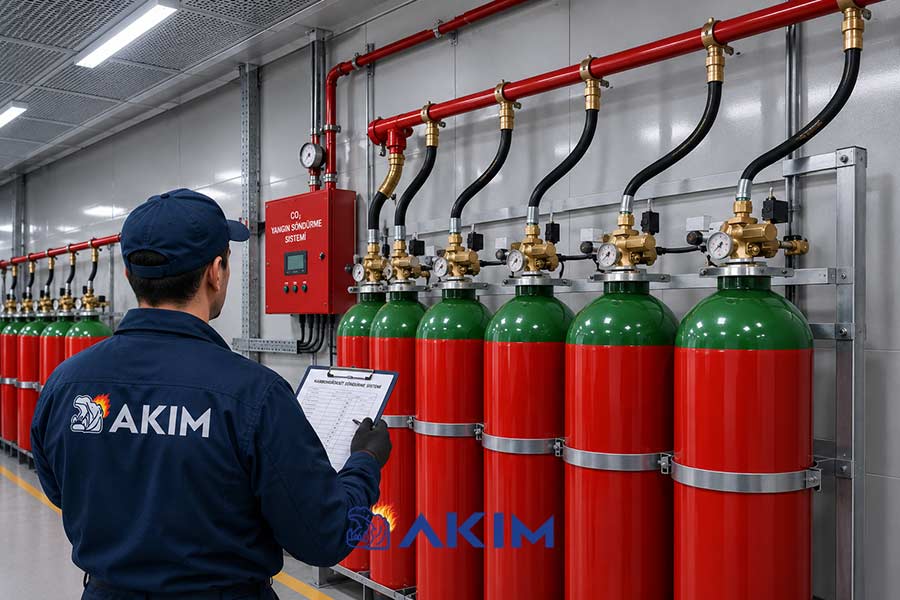
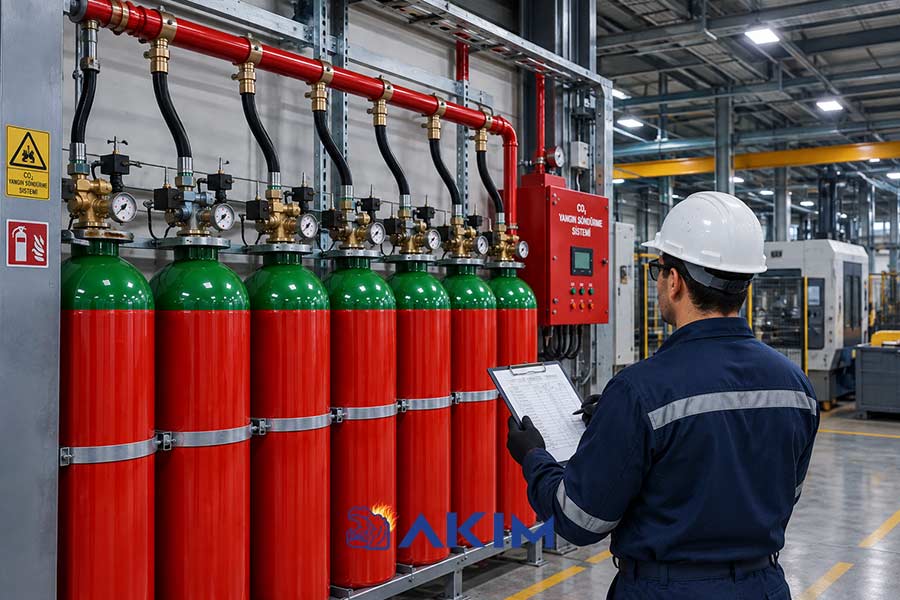
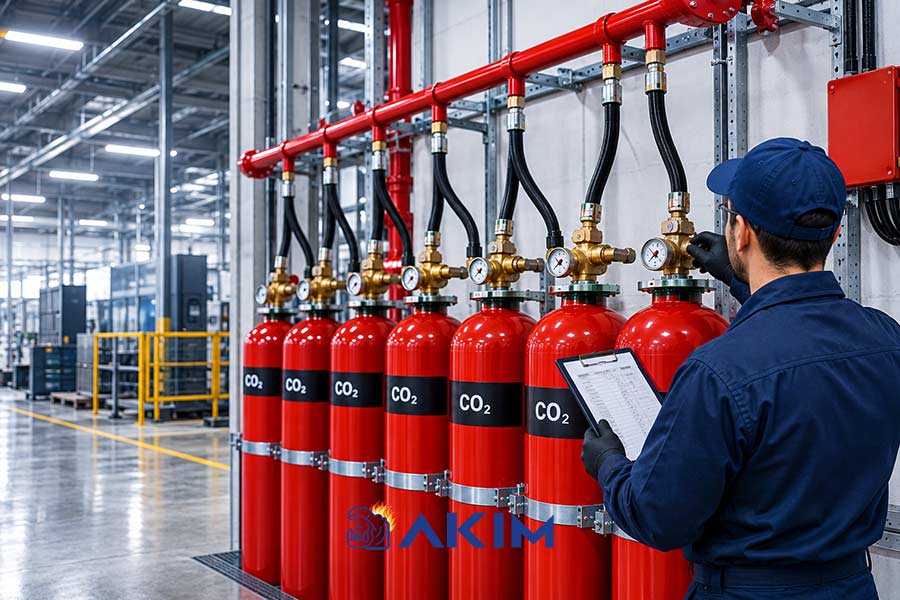
Fire safety solutions should be determined according to the risk posed by the protected area and the characteristics of the equipment present. Especially in areas containing electrical power, flammable liquids, sensitive machinery, and industrial production equipment, water or foam may not always be an appropriate solution. Karbondioksit Gazlı Yangın Söndürme Sistemleri, is one of the fixed fire suppression solutions used to respond rapidly to fires in areas with such special risks.
CO₂ gas suppresses fire by reducing the oxygen concentration required for combustion to continue. Its lack of residue after discharge is an important advantage, especially in areas containing machinery and electrical equipment. However, because high concentrations can pose a serious risk to human life, the system design, application area, and safety scenario must be planned with great care.
Current Turkish fire regulations state that gaseous fire suppression systems must be designed according to the relevant standards, based on the facility's needs, using current and certified systems. Audible and visual warnings to enable personnel evacuation before gas discharge are also mandatory.
Key Features
Understanding the key features is important for evaluating why carbon dioxide systems are used in certain industrial and technical areas. The safety criteria that must be considered during use should be evaluated together with the system's advantages.
Leaves No Residue
CO₂ gas leaves no dust, foam, or chemical residue after discharge. This is an important advantage in areas containing machinery, electrical equipment, and technical equipment where lengthy post-fire cleaning is undesirable. It helps reduce potential secondary damage after suppression in areas containing sensitive systems.
Electrically Non-Conductive
Carbon dioxide is a non-conductive fire suppression agent. Therefore, following an appropriate risk assessment, it can be used in areas containing electrical equipment, control panels, and energy systems. The Istanbul Fire Department also states that CO₂ extinguishers leave no residue and can be used on electrical devices without creating a short-circuit risk.
Local Application Capability
Systems can be designed not only to protect an entire volume, but also according to the local application principle for specific equipment where fire risk is concentrated. Local applications can be considered particularly for open or semi-open machinery areas, printing machines, and specialized production equipment.
Environmentally Friendly
An important distinction should be made under this heading: CO₂ systems leave no residue and have different characteristics from halon-type agents that deplete the ozone layer. However, because carbon dioxide is also a greenhouse gas, the term “environmentally friendly” should not be considered an absolute advantage. System selection should consider environmental impacts together with fire risk and technical requirements.
Features of Carbon Dioxide Fire Suppression Systems
Karbondioksit Gazlı Söndürme Sistemlerinin The physical properties of the gas and its fire suppression mechanism are key aspects. CO₂ stored under high pressure in the system is directed to the protected area or equipment through piping and nozzles after activation.
Carbon dioxide gas is colorless and odorless under normal conditions. Therefore, it may not be possible to detect the release of gas through human senses. This clearly demonstrates why audible and visual warnings are critical before the system activates.
Non-Conductive
Its lack of electrical conductivity allows CO₂ systems to be used in certain hazardous areas containing electrical and electronic equipment. However, the system must be engineered according to the fire class, equipment characteristics, and conditions of use of the area.
Leaves No Residue
The fact that no powder or foam cleanup is required after suppression can save time for businesses. This feature can be advantageous, especially in facilities where rapid resumption of production or technical operations is important.
Has a Suffocating Effect
CO₂ prevents the fire from continuing by reducing the amount of oxygen in the environment. However, the same mechanism can pose a serious danger to human health. Therefore, occupancy, evacuation capabilities, and safety scenarios for the protected area must be fundamental parts of the design.
Critical Safety Warning: Effects on Human Health
Critical Safety Warning: Effects on Human Health, karbondioksitli sistemler değerlendirilirken kesinlikle göz ardı edilmemesi gereken en önemli konulardan biridir. At high concentrations, CO₂ can displace oxygen required for breathing and create a life-threatening hazard for people in enclosed spaces.
Therefore, alternative fire suppression solutions should also be evaluated when selecting a system for small, enclosed areas that are continuously occupied. In areas where CO₂ will be discharged, evacuation procedures, audible and visual warnings, delay times, manual control equipment, and access safety where necessary must be properly planned.
Turkish regulations explicitly require audible and visual warnings for gaseous fire suppression systems during automatic gas discharge to indicate system activation and enable people to evacuate the protected area.
Common Applications
Common applications show that CO₂ systems are considered particularly for industrial and technical facilities with specific fire risks. Because the same system is not suitable for every area, professional site assessment and risk analysis are important before selection.
CO₂ systems can be used, with appropriate design criteria, in areas containing electrical generation and distribution systems, generators, certain technical rooms, and energy equipment. Gaseous systems can provide an alternative for special risks where water use could cause secondary damage.
Industrial Production Facilities
Local or total-flooding solutions can be applied to production machinery, printing systems, paint and process equipment, and specialized production lines. The system should be designed considering the facility's process characteristics and fire load.
Marine Applications
Fixed carbon dioxide fire suppression systems have also long been used in marine applications. They can be used particularly in engine rooms and certain technical areas in accordance with applicable standards.
Sensitive Machinery Areas
For production-critical machinery, damage caused by water or powder residue after a fire can result in significant costs. Because CO₂ suppression leaves no residue, it can be considered for protecting sensitive machinery areas under appropriate conditions.
Design and Regulatory Standards
Design and regulatory standards are among the most important aspects demonstrating that the system consists of more than cylinders and piping. Cylinder capacity, gas quantity, pipe diameters, nozzle layouts, protected volume characteristics, ventilation systems, and detection scenarios must be determined through engineering calculations.
Under the Regulation on Fire Protection of Buildings, the TS ISO 14520 standard is used as the basis for designing gaseous fire suppression systems. The regulation also requires natural ventilation openings and ventilation systems to be properly controlled during gas discharge.
In international practice for carbon dioxide suppression systems, NFPA 12 is one of the primary standards for CO₂ fire suppression systems, with current editions published by NFPA.
After system installation is completed, regular maintenance, inspection, and testing must not be neglected. The condition of cylinders, mechanical connections, control equipment, detection systems, and discharge scenarios should be inspected by qualified teams at defined intervals.
Determine the Right CO₂ Fire Suppression Solution for Your Facility
The same fire suppression system is not the right solution for every fire risk. The characteristics of the protected area, occupancy, equipment type, and operational risks must be carefully evaluated. As Akım Yangın, we provide solutions tailored to your needs throughout site assessment, risk evaluation, engineering, installation, and maintenance processes.
Free Project Analysis
We provide customized solutions tailored to your needs, together with competitive quotations and professional support from our expert team, as quickly as possible.