Correct intervention during the first minutes of a fire plays an important role in reducing loss of life and property. Automatic fire suppression systems are widely used in factories, warehouses, shopping malls, hotels, office buildings, and high-capacity facilities to help control the spread of fire. Among these systems, sprinkler applications are one of the most common solutions for controlling a fire during its early stages.
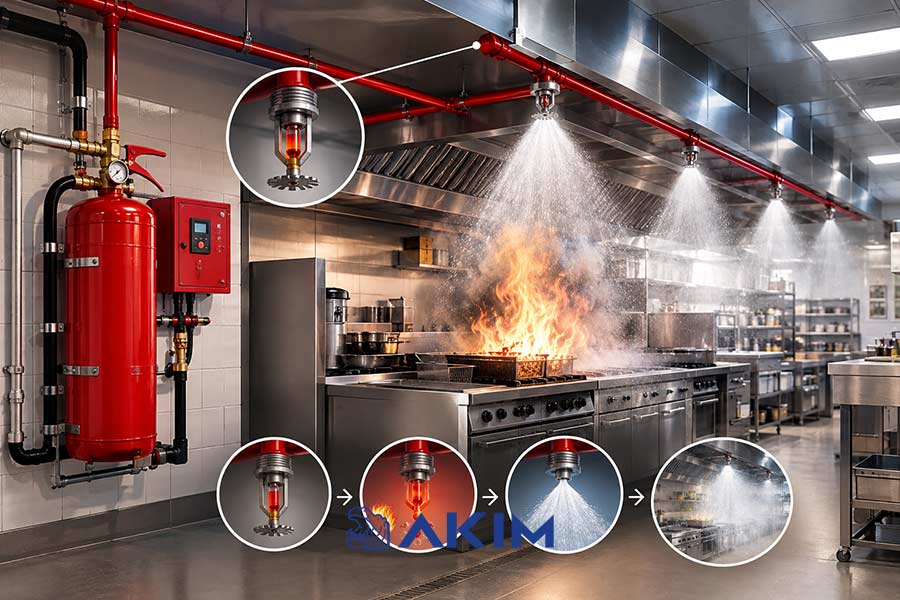
Sprinkler Fire Suppression Systems operate by detecting the heat generated by a fire, activating only the sprinkler head required in the affected area, and discharging water in a controlled manner. This helps delay the spread of fire to other areas and contributes to keeping the fire under control until firefighting teams arrive.
At Akım Yangın, we evaluate project design, hydraulic calculations, material supply, installation, and testing processes according to the building’s intended use and fire risk profile. The effectiveness of sprinkler systems depends not only on the installation of pipes and sprinkler heads, but also on proper system design.
How Does a Sprinkler System Work?
The answer to the question “How does a sprinkler system work?” is actually quite straightforward: the system activates locally when the heat generated by a fire causes the heat-sensitive element inside a sprinkler head to reach a predetermined temperature. When a fire is detected, all sprinkler heads are not expected to open simultaneously; depending on the operating conditions, sprinkler heads exposed to sufficient heat may activate individually or within the area where the fire is located.
This operating principle helps prevent water from being discharged unnecessarily throughout the entire area and enables rapid intervention at the location of the fire.
Heat Detection
A temperature-sensitive element is located inside the sprinkler head. When the ambient temperature rises due to a fire and reaches the sprinkler’s rated activation temperature, this element activates, allowing water to be discharged into the affected area.
An important distinction should be noted here: a sprinkler head does not operate like a smoke detector. Its primary activation mechanism is based on an increase in ambient temperature. Therefore, sprinkler systems and fire detection systems perform different functions and may be evaluated together depending on the project requirements.
Localized Intervention
Once the sprinkler head activates, water is discharged toward the area where the fire is present. Depending on the development of the fire and the conditions of the environment, additional sprinkler heads may also activate.
This localized intervention approach aims to limit the development of the fire at its point of origin. This feature is particularly important in large-volume buildings.
Fire Suppression
Water discharged from the sprinkler helps reduce the heat of the fire and control the combustion process. The extent to which the system can control a fire depends on various factors, including the hazard classification, design density, sprinkler head layout, water supply, and hydraulic calculations.
Therefore, simply installing sprinkler heads on the ceiling is not sufficient. The entire piping system must be designed in accordance with the relevant engineering calculations.
Sprinkler system types vary depending on the building’s intended use, ambient temperature, fire risk, and the required intervention scenario. When selecting the most suitable system, the building’s physical conditions and fire risks should be evaluated together.
System Type
Operating Principle
Most Common Applications
Wet Pipe System
The piping system is constantly filled with water. Water reaches the activated sprinkler head directly.
Heated warehouses, offices, stores, hotels, and general-purpose areas
Dry Pipe System
The piping system contains pressurized air or nitrogen instead of water. When a sprinkler head activates, water enters the piping system.
Parking garages, warehouses, and similar areas where there is a risk of freezing
Deluge System
Open-type sprinkler heads are used, and following detection, a large volume of water is discharged into the designated area.
Industrial facilities with high fire risks, process areas, and special hazard areas
Pre-Action System
The system is activated in a controlled manner by the fire detection system; depending on the system design, the admission of water into the piping and activation of the sprinkler heads are subject to specific conditions.
Critical areas where preventing water damage is particularly important, special storage areas, and technical spaces
When selecting a system, ambient temperature, the risk of freezing, fire load, and the building’s intended use should be evaluated together. Particularly in facilities with special hazards, a project-specific engineering approach is required rather than a standard application.
Sprinkler Head Installation Types
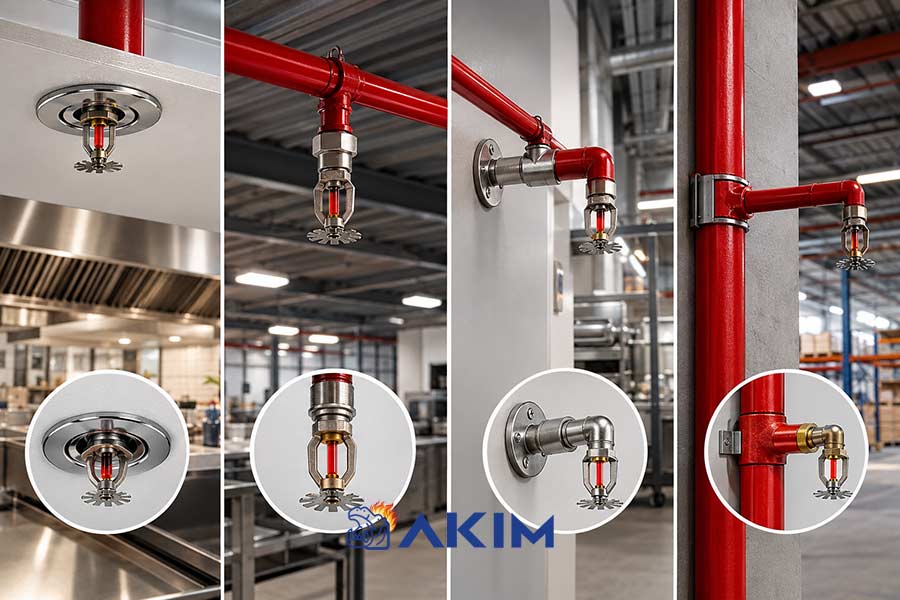
Sprinkler head installation types are determined according to ceiling height, architectural structure, piping arrangement, and the characteristics of the fire risk. Proper positioning of sprinkler heads is important to ensure that water can be distributed appropriately throughout the protected area.
Pendent
Pendent sprinkler heads are suspended from the ceiling and installed to discharge water downward. They are commonly used in commercial buildings, offices, stores, and many types of enclosed spaces.
The position of the sprinkler head and pipe connections should be designed by taking the ceiling and suspended ceiling structure into consideration.
Upright
Upright sprinkler heads are positioned upward and distribute water according to the discharge pattern above the sprinkler head. They may be preferred in industrial areas with open ceilings or in applications where piping is installed in the upper part of the facility.
When selecting sprinkler heads, care should be taken to ensure that structural elements and other installations do not obstruct the water distribution pattern.
Sidewall
Sidewall sprinkler heads are positioned close to walls and distribute water toward the designated protected area. They may be considered particularly in areas where the ceiling structure or architectural conditions are not suitable for the use of standard ceiling-mounted sprinklers.
For all three sprinkler head types, placement should not be based solely on achieving a visually uniform distribution; it should be carried out in accordance with the applicable design criteria.
Where Are Sprinkler Fire Suppression Systems Mandatory?
The question “Where are sprinkler fire suppression systems mandatory?” cannot be answered correctly based on a single square-meter threshold or a single building type. In Türkiye, the requirement for automatic sprinkler systems is evaluated together with criteria such as the building’s intended use, structural characteristics, number of floors, building height, total floor area, and fire risks.
Sprinkler systems may be required particularly in high-rise buildings, enclosed areas exceeding certain size thresholds, shopping and commercial buildings, accommodation facilities, certain industrial buildings, storage areas, and sections involving special hazards.
In addition, the design of automatic fire suppression systems becomes particularly important in buildings where fire can spread rapidly, where the fire load is high, or where large numbers of people are present.
It is important to note that the question “Are sprinklers mandatory?” should not be answered solely by considering the total floor area of the building. The entire project should be reviewed, and the requirement should be assessed in accordance with the applicable provisions of the relevant fire safety regulations.
Legal Requirements (Türkiye Regulation on Fire Protection of Buildings)
In terms of Legal Requirements (Türkiye Regulation on Fire Protection of Buildings), the Regulation on Fire Protection of Buildings is one of the primary pieces of legislation used when evaluating sprinkler systems. The regulation includes various provisions addressing different building occupancy classifications and structural groups in terms of fire safety. Before implementation, the current version of the applicable legislation should always be checked.
Where automatic sprinkler systems are required, it is not sufficient simply to install the system. It must also be properly designed and implemented in accordance with the relevant technical criteria. Factors such as the adequacy of the water supply, pump assembly, pipe diameters, sprinkler head layout, alarm valves, and testing and drainage arrangements require the system to be evaluated as a whole.
It is also important for the sprinkler system to operate in coordination with other fire safety equipment. The fire detection and alarm system, fire pumps, fire water storage tank, and other mechanical fire protection systems should be evaluated as part of the overall project design.
Proper Planning for a Reliable Sprinkler Project
To achieve the expected performance from a sprinkler system, engineering and installation quality are just as important as product quality. Incorrect sprinkler head selection, insufficient water flow, improper pipe sizing, or unsuitable layout can prevent the system from delivering the expected performance during an actual fire.
At Akım Yangın, we evaluate the intended use of your building and its fire risks, and professionally plan the entire process, from determining the appropriate system type and carrying out hydraulic calculations to material selection, installation, and testing.
If you are planning a sprinkler system for your factory, warehouse, business center, hotel, or commercial building, the first step is to create the right project design. You can contact Akım Yangın to evaluate the most suitable solution for your building and receive a site assessment and technical information.
The right sprinkler system is not merely one of the measures taken against fire; it is an important component of a comprehensive fire safety approach.
Free Project Analysis
We provide customized solutions tailored to your needs, together with competitive quotations and professional support from our expert team, as quickly as possible.