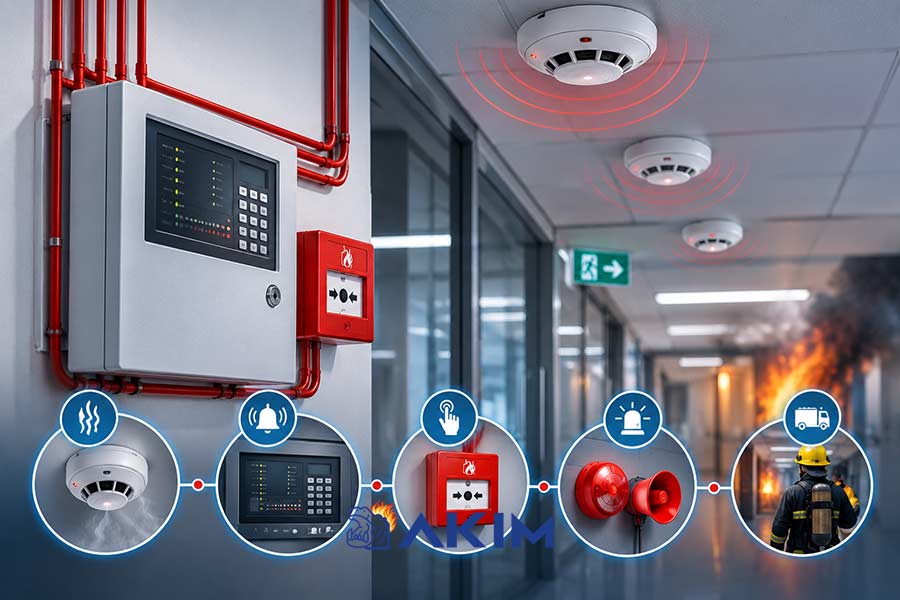
Fire Detection and Alarm Systems are among the fundamental components of fire safety infrastructure, enabling fires to be detected at the earliest possible stage, people inside the building to be alerted, and the required response scenarios to be activated. The first minutes after a fire starts are critical for life safety and property protection. Therefore, rather than a system that simply generates an alarm, a comprehensive solution should be preferred—one that provides accurate detection, monitors faults, transmits alarms to the relevant locations, and can communicate with other safety systems when required.
When selecting a fire alarm system, the building’s intended use, number of floors, architectural structure, occupant density, fire risk, electrical infrastructure, and existing fire suppression systems should be evaluated together. While conventional solutions may be sufficient for small and simple buildings, the point-specific detection and monitoring capabilities provided by addressable systems offer significant advantages in large and complex facilities.
Types of Fire Detection Systems
Types of Fire Detection Systems are primarily evaluated as conventional and addressable systems. In addition, technologies such as analog addressable, wireless addressable, and aspirating smoke detection systems can be used for specific projects. The appropriate system should not be determined solely by the number of devices; the building’s fire scenario and risk assessment should also be taken into consideration.
In conventional systems, detection is performed on a zone basis, whereas addressable systems can identify the location of the specific device that has triggered an alarm with greater precision. Particularly in multi-story buildings, hotels, hospitals, manufacturing facilities, shopping centers, and large warehouses, the ability to provide precise location information can facilitate the response process.
Conventional Fire Detection Systems
Conventional fire detection systems are among the simpler and more straightforward solutions in fire alarm technology. Detectors and manual fire alarm call points are grouped into specific zones. When a detector triggers an alarm, the control panel indicates the area in which the fire has been detected. However, the panel generally identifies the zone where the alarm originated rather than the exact location of an individual detector.
This structure can be an economical solution for buildings where fire alarm monitoring is relatively simple and zone-based detection is considered sufficient. A technical document published by the Turkish Ministry of Environment, Urbanization and Climate Change also states that conventional systems operate on a zone basis and can be preferred for applications with simpler structures.
How Does It Work?
The operating principle of a conventional system is quite straightforward. A signal received from a detector or manual fire alarm call point reaches the fire alarm control panel through the zone to which it is connected. The panel evaluates the incoming signal and activates audible and visual alarm devices according to the programmed scenario.
Zone Logic
The building is divided into different zones according to its fire risks and architectural structure. Each zone may contain a certain number of detectors and manual fire alarm call points. When an alarm occurs, the panel displays the relevant area, such as “2nd Floor East Zone,” helping the response team identify and reach the appropriate location.
Signal Transmission
The alarm signal generated by a detector or manual call point is transmitted to the control panel through the relevant fire alarm circuit. The system can monitor not only fire conditions but also certain fault conditions, such as cable breaks and short circuits.
Panel Alert
When the panel receives an alarm signal, it generates audible and visual warnings. Depending on the scenario defined in the project, the system can also be integrated with sirens, flashers, emergency voice evacuation systems, smoke control systems, or other building automation equipment.
Addressable Fire Detection Systems
Addressable Fire Detection Systems are advanced solutions particularly preferred in large and complex buildings where identifying the exact location of a fire source is important. Each device has its own unique address within the system. This allows the fire alarm control panel to answer not only the question “Which zone has an alarm?” but also “Which device has triggered the alarm?”
This feature can help reduce response times, particularly in multi-story buildings and facilities containing a large number of detection devices. The Ministry's technical document also states that addressable systems are preferred in complex and multi-story buildings because they can identify the specific point of a potential fire hazard by indicating the relevant address.
An addressable system consists of more than just a control panel and detectors. Different field devices responsible for detection, alarm notification, control, and communication work together as an integrated system.
Addressable Fire Alarm Control Panel
It is the central management point of the system. It evaluates information received from detectors, manual fire alarm call points, and modules. It displays alarm and fault conditions, can record events, and manages programmed fire scenarios.
Addressable Detectors
Detectors that identify smoke, heat, or other indications of fire operate in continuous communication with the control panel. Through addressing, the specific detector that has triggered an alarm can be identified. In analog addressable systems, certain detectors can also transmit measurements related to environmental conditions to the control panel.
Addressable Manual Fire Alarm Call Points
They allow a person who first notices a fire to manually activate the system. Break-glass or resettable models can be selected depending on the project requirements. Displaying the address of the call point on the control panel helps the response team locate the alarm point more quickly.
Input/Output Modules
They enable the fire alarm system to communicate with other mechanical and electrical systems. Depending on the programmed scenario, connections can be established with various equipment, including fire suppression systems, ventilation equipment, fire dampers, elevators, door systems, and building automation systems.
What Are the System Components?
The answer to the question “What Are the System Components?” may vary depending on the size of the project and its risk classification. However, in a basic fire detection and alarm system, the control panel, detection devices, and alarm notification devices work together.
Fire Alarm Control Panel: Evaluates information received from all field devices and manages alarm and fault conditions.
Smoke Detectors: Detect smoke particles generated by a fire and provide early warning.
Heat Detectors: Used to detect specific temperature levels or changes in ambient temperature.
Manual Fire Alarm Call Points: Allow a person who sees a fire to manually activate the system and initiate an alarm.
Sounders and Flashers: Used to provide audible and visual warnings to people inside the building in the event of a fire.
Depending on the project requirements, flame detectors, gas detectors, beam detectors, aspirating smoke detection systems, input/output modules, and repeater panels can also be incorporated into the system.
Comparison Table makes it easier to understand the key differences between conventional and addressable systems.
Feature
Addressable Systems
Conventional Systems
Application Area
Preferred for medium- and large-scale buildings requiring detailed monitoring.
Preferred for small- and medium-scale buildings with simpler structures.
Fault/Alarm Detection
The specific device from which an alarm or fault originates can be identified.
The zone where the alarm originates can be identified; device-level location identification is limited.
Installation Cost
Initial costs may be higher due to the system's advanced features.
Initial costs are generally lower due to the simpler infrastructure.
Cabling
A large number of devices can be managed through a loop configuration.
Separate circuits can be used for each zone.
The important consideration here is not simply to compare prices. A fire alarm system should be designed according to the specific risks of the building. A lower initial investment cost does not necessarily mean a more suitable solution for every project. Likewise, an addressable system is not necessarily required for every small building.
Legal Requirements
Legal Requirements should be evaluated according to the building's intended use, structural characteristics, size, and fire risks. In Türkiye, the Regulation on Fire Protection of Buildings has an important place among the primary regulations concerning fire safety. In accordance with the regulation and relevant technical requirements, the principles governing the design, installation, and inspection of fire detection and alarm systems are established.
The Ministry's current technical document emphasizes that the detection, alarm, communication, and control components of fire detection and alarm systems should be designed and installed in accordance with TS EN 54. It also highlights the importance of the system being capable of monitoring faults such as cable breaks and short circuits. In addition, provisions address the use of audible and visual warnings in the relevant areas when a fire alarm is activated.
Particularly when designing systems for hotels, hospitals, schools, shopping centers, factories, warehouses, offices, business centers, and high-rise buildings, the assessment should not be limited to device placement. The building's intended use, escape routes, fire compartments, occupant density, existing fire suppression systems, and other safety systems should all be evaluated together.
In buildings equipped with fixed fire suppression systems, it may also be necessary for the fire alarm system to detect when the suppression system is activated and for the required contacts to be transmitted to the alarm system. Therefore, it would not be appropriate to consider the fire alarm project independently of other fire safety systems.
The most important consideration in fire safety is not simply installing devices to meet regulatory requirements, but ensuring that the system operates correctly and rapidly in an actual fire scenario. For this reason, site assessment, risk evaluation, proper device selection, suitable cabling, system design, commissioning, and periodic maintenance should be considered as an integrated process.
At Akım Yangın, we evaluate the characteristics of your business and building to determine the appropriate fire detection and alarm solution. We provide professional support throughout the design, material supply, installation, and commissioning processes of conventional and addressable systems. You can contact us to determine which system is more suitable for your building and to develop a solution tailored to your needs.
Free Project Analysis
We provide customized solutions tailored to your needs, together with competitive quotations and professional support from our expert team, as quickly as possible.